
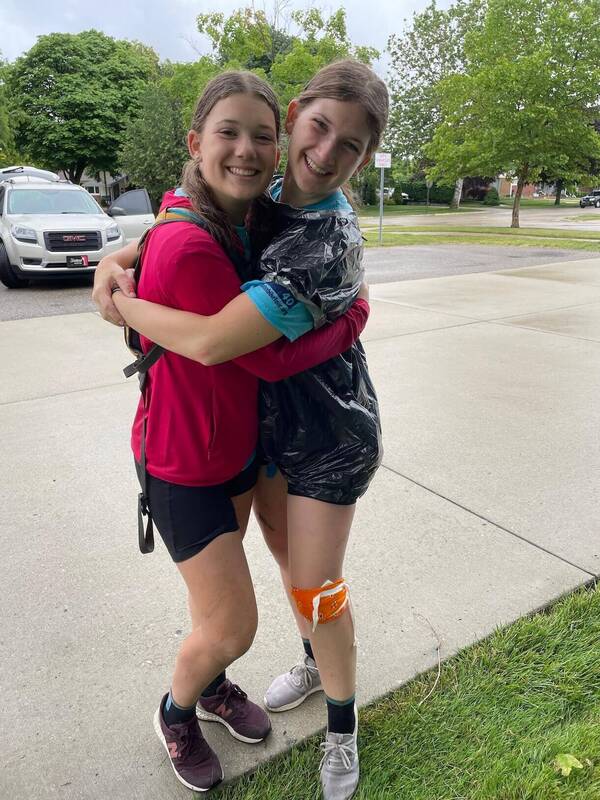
I adjusted the black trash bag that clung to my shoulders, shaking off the droplets of water that accumulated on the thin plastic. In a desperate attempt to stay dry and warm, I’d ripped arm and head holes into a trash bag to wear as a makeshift raincoat, but the wind and unrelenting rain had soaked the DIY poncho. Water ran in rivulets from my helmet down my neck, soaking my shirt and making it stick uncomfortably to my back as I sat on the curb. As I tried to drink water from a grubby plastic bottle, struggling to take deep breaths and calm my pumping heartbeat, my sister dumped her water bottle onto my left knee. The splash of water turned red, running down my shin and staining my sock pink, but—
“I don’t think there’s any gravel in it anymore,” Clare said.
I looked down at my newly won battle scar, a nasty set of seven gouges on my leg where the gears of a bike had caught my knee.
We’d been riding through rain for twenty miles, me in my trash bag and my sister in a plastic poncho she’d snagged at a water stop. Clare and I had made the best of a particularly cloudy situation as we finished the last day of a weeklong bike trip, with her setting the pace and me on the lookout for cars behind us, as always. Though my trash bag poncho whipped against me in the wind, though the rain was relentless, though the cars splashed us as they sped by, we traded stories and sang songs along the route like we’d done since we were little.
We had one mile left. One. Then, as I was taking my lane at a busy intersection, Clare’s bike slipped on the cement. When it rains, the roads get scarily slick; not only does motor oil rise to the surface of the asphalt, but the white stripes on the shoulder can cause your bike to skid out from underneath you in a split second. When my sister’s bike caught a crack in the road and she wiped out, I was going too fast to swerve and I crashed on top of her. I crashed directly onto the teeth of the gears of her road bike, but I didn’t notice as I extricated myself from the pileup of our bikes. Oncoming traffic bore down on us as we scrambled off the pavement and threw our bikes into the grass to survey the damage.
That’s when I, nearly blinded by the pouring rain and shocked by the crash, glanced down and saw streams of blood running down my shin. My knee looked like something had taken a bite out of it, with teeth marks sunk into the side of my leg and little bits of gravel pressed into my knee and stuck to the bloody scrapes. We didn’t have a first aid kit, so the best solution was to pull out our water bottles and dump what was left onto my wound. Clare had a couple of scrapes, and my elbow stung, but the clear issue was the gashes that branded my knee. Sitting on that curb, trying to catch my breath, the last thing I wanted to do was hop back on my bike and ride to the final stop, even though it was only one mile. I tried to take a deep breath, and I wasn’t in too much pain, clearly, because I hadn’t even noticed the injury at first, but—
“Clare, does that look like I need stitches? What should we do?”
How am I supposed to get myself to the end of the ride?
Would I be able to pedal?
Who do we ask for help?
What could I do to keep calm?
What should I do?
The unknown gets so much harder when you’re put in an uncomfortable situation, a situation where you’re wearing a trash bag and getting rained on and bleeding. I like a certain degree of control over my life, the ability to push myself where I hope to go and rely on myself. Even when I was little, I’d always insist on the same spot at the dinner table, the same books before bed, because I liked having the consolation of a predictable routine. Whether it’s in school, while baking, or at dance class, the ability to control my path has always been important to me. Biking has always afforded me the ability to spend time passing through nature, to work hard, and, importantly, to choose where I go at my own pace. I relish that unique independence. My sister and I have spent countless hours and hundreds of miles on our bikes together, waving at people on their porches and reveling in the exhilarating freedom of taking ourselves where we want to go, even on days when we were inundated by rain. But in those moments of crisis, when you’re running on adrenaline and maybe a granola bar, and the manual flies out the window, I’ve always struggled with what to do. That rainy day, looking at the way my knee was sliced open, I was overcome by the out-of-control nature of it, where I was completely unprepared to deal with an injury and didn’t even know if my leg would work enough to pedal me that last mile.
What should I do?
What should I do?
As my mind raced at a mile a minute, my sister, ever prepared, pulled out an orange bandana from the depths of her bike bag. She handed it to me, and I gingerly tied it around my now-swelling knee, and while we didn’t have bandages or gauze, at that moment I realized my injury could have been much, much worse. It’s moments like these where a deep breath is crucial, a moment to slow time and focus, a moment to stop thinking so hard and prioritize oxygen. I was with someone who could help me, who could solve a problem and who could encourage me to get up and go on. I didn’t have to figure out what to do on my own. I still had all my limbs and, thanks to my helmet, no head trauma, and while it was still raining, I had a dry change of clothes just a mile down the road. While one mile left can feel like it stretches on forever when you’re injured, that mile is nearly the end. We were almost done, and Clare had found a solution that would get me to the end, where we could then regroup and figure out what to do next.
I’ve just got to push through. What am I gonna do, wait here for who knows how long until I can get rescued? We’re so, so close, and just sitting here can’t be an option.
“I’ve got it, Clare,” I said as I pushed myself onto my bike and shakily started pedaling again, Clare carefully riding behind me and scanning for cars behind us.
I barely remember that last mile, just the twinge of pain in my knee every time I’d pedal, the way cars splashed us as they zipped past. Setting my face to the now-dissipating rain, I slowly pedaled the longest mile of my life, praying the bloodstained bandana wouldn’t fall off and expose my knee to the open air. We finally rolled up to the last stop, a school, which was abuzz with hundreds of other bike riders, and I desperately limped through piles of bikes and duffel bags to find our Aunt Ruth. With Clare in tow, still in my trash bag poncho and helmet, held together by a bandana, I found my great aunt sitting at a plastic church table in the cafeteria with a turkey sub sandwich.
When I pulled off my makeshift bandage, we were greeted with a gnarly sight: the teeth of the gear had caught the side of my knee and dug in, creating seven triangular wounds, though the bleeding had nearly stopped by then. With my leg up and an ice pack at the ready, I watched as Aunt Ruth, the large animal vet that she is, gently applied hydrogen peroxide with a deft hand to make sure my wound wouldn’t be infected. Sitting on that metal folding chair in that old high school cafeteria, I had no idea that nearly ten other riders had fallen at the same intersection, that an ambulance had left moments before we’d fallen, that I was one of the luckier ones. I truly had walked out of it with just a few ugly scratches, but it didn’t feel like I was very lucky. Even as Aunt Ruth cleaned me up, as Clare filled up our water bottles again and found us something to eat, I still felt so untethered, so out of my element.
I still might need stitches.
What if it’s worse than it looks?
Could I have done anything to stop this from happening to me?
What should I do?
But actually, I didn’t have to fend for myself, because I had people who worried about me, people who cared for me, and even people who took down my name and number so they could check up on me later. By the time my parents rolled into the school parking lot, I had gauze wrapped around my leg and a bag of barbecue Lays in hand, though I was a little dazed from the adrenaline of the last hour or so. My mom and Aunt Ruth conferenced, deciding whether going to an urgent care would be a good idea, and ultimately, I wound up not needing stitches. Despite the unusual placement and type of injury, it wasn’t as deep as I’d initially feared. I’d become so used to being mentally prepared for the challenges I faced, like anticipating finals stress or readying myself for hot days at work, that when the truly unexpected happened, I’d panicked. Sitting on the side of the road, wearing a trash bag and armed with only a water bottle and a bandana, I’d blown the situation out of proportion and created the worst-case scenarios. I had to learn how to keep moving, even when it felt impossible, and how to seek out help and admit when I felt intensely uncomfortable and out of control. With a few deep breaths, a snack, and the help of people who cared about me, I was able to calm down, problem-solve, and determine the best path to take.
That bike injury hasn’t hurt my love of riding my bike, but it has served as a reminder to prepare myself as best I can, while also recognizing that there is always so much that can go out of control. The scar I now bear is an echo of that day, and though I’ll sometimes tell curious people it’s a token from a megalodon attack, it’s a reminder that I can be calm in a crisis.
In asking for help, relying on those who could care for me, taking a deep breath, and finding a moment of peace, I talked myself off the worst-case scenario train and was able to hop back on my bike. Even now, when I’m faced with bad news, rejection, misunderstanding, or frustration, I’m able to take a step back and focus on remaining calm, even when it’s the last thing I want to do. Now, every time I put on my helmet and hop on my bike, I know that I can weather any injury, not because I have extra bandages or a first-aid kit, but because even if I can’t fully control the situation, I can take control of and advocate for myself. And so, I keep pedaling.
Discussion Questions
1) The writer begins the essay in medias res, sitting on a curb in a trash-bag poncho with a gash in her knee that might need stitches. How does she use sensory details, dialogue, pacing, and humor to create tension and keep readers engaged throughout the narrative?
2) The writer describes herself as someone who values preparation, routine, and control. How does the bike accident challenge her usual way of navigating the world? How does learning that many other riders crashed at the same intersection change her understanding of what happened and her ability to respond to situations beyond her control?
3) The writer learns that she can't always control what happens to her, but she can control how she responds. Does the writer portray resilience as an individual quality, a collective one, or a combination of the two? What evidence from her essay supports your interpretation?